

*This post may contain affiliate links for which I earn commissions.*
Photography is often treated as a technical hobby.
People talk about lenses, lighting ratios, camera bodies, editing software, and social media algorithms. While those things have their place, they can distract from something much deeper.
For introverts especially, photography can be an act of mindful observation.

It is not about capturing attention. It is about paying attention.
When you step behind a camera, you give yourself permission to slow down. You begin to notice what others rush past. The way morning light falls across a table. The texture of peeling paint. The quiet symmetry of leaves on a branch. The expression on someone’s face when they are not aware of being watched.
Photography becomes less about producing and more about perceiving.
The Introvert Advantage
Introverts are natural observers.
You likely notice subtle shifts in tone, body language, and atmosphere. You may be more comfortable on the edge of a group, quietly taking in details rather than dominating conversation.
Photography gives that observational strength a tangible outlet.
Instead of feeling like you are standing apart from the action, you are intentionally studying it. You are looking for patterns, contrasts, and moments of stillness. You are translating what you see into an image.
This reframes quietness as a skill rather than a limitation.
Slowing Down the Moment
Mindfulness is the practice of being present without judgment. Photography can be a doorway into that state.
When you raise a camera or even a smartphone, you pause. You frame. You consider. You ask yourself, what am I actually seeing?
Is the light warm or cool?
Is the composition balanced or asymmetrical?
What feeling does this scene carry?
In that moment, you are not thinking about your to do list. You are not replaying conversations in your head. You are engaged with the present.
This simple act of noticing can lower stress and quiet mental noise.
Seeing the Ordinary Differently
One of the most powerful aspects of photography as mindful observation is learning to see beauty in ordinary places.
You do not need dramatic landscapes or exotic destinations. You can start in your own home.
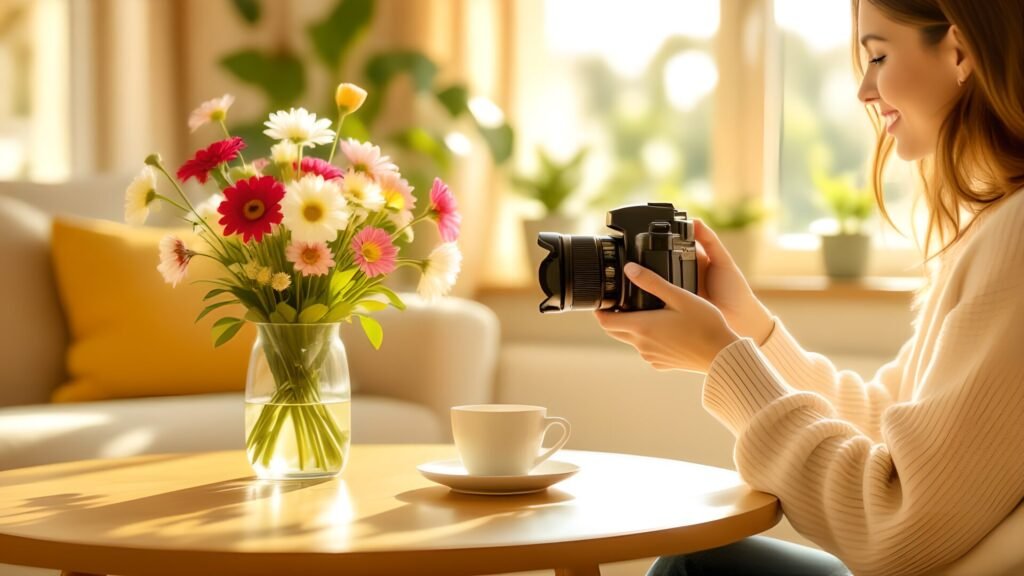
A cup of tea on a wooden table.
The shadow of a plant against the wall.
The soft folds of a blanket in afternoon light.
When you approach everyday scenes with curiosity, the familiar becomes interesting again.
This shift changes more than your photos. It changes how you experience your environment. You begin to feel less rushed and more grounded.
Developing a Gentle Practice
You do not need to turn photography into another performance goal.
Instead of focusing on posting, selling, or gaining followers, begin with a private practice.
Choose a simple theme for the week. Light. Texture. Stillness. Doors. Hands. Nature.
Each day, take one photo related to that theme. Do not over edit. Do not judge harshly. Simply observe and capture.
This small daily ritual trains your attention. Over time, you will notice that you see compositions before you even lift the camera.
Your awareness sharpens.
Embracing Quiet Environments
Introverts often feel most comfortable in calm spaces. Photography allows you to lean into that preference.
Early mornings are ideal. The light is soft. The world is quieter. You can walk slowly and notice details without distraction.
Nature is another restorative environment. Leaves, water, clouds, and shadows offer endless subjects that do not demand conversation.
Even urban spaces have quiet corners. Alleyways, reflections in windows, patterns in brickwork.
You do not need noise to create meaningful images.
Letting Go of Perfection
One of the traps in creative hobbies is perfectionism. You may compare your photos to professionals and feel discouraged.
Mindful photography invites a different approach.
Instead of asking, is this perfect, ask, what does this image make me feel?
Sometimes a slightly blurred photo carries more emotion than a technically flawless one. Sometimes a simple composition speaks more clearly than something elaborate.
The purpose is not to impress. It is to connect with your own perception.
When you release the pressure to perform, creativity feels lighter.
Photography as Reflection
Photos can also become a quiet form of journaling.
At the end of the week, review what you captured. What patterns appear? Did you gravitate toward light or shadow? People or objects? Color or minimalism?
Your images may reveal your mood, your interests, even your stress levels.
Photography becomes a mirror.
You might notice that during busy weeks, your photos feel darker or more chaotic. During calmer periods, you capture open spaces and soft tones.
This awareness helps you understand yourself more clearly.
Creating Without Noise
In a world saturated with content, photography as mindful observation is an act of resistance.
You are choosing depth over speed. Presence over performance. Observation over noise.
You do not need an expensive camera to begin. A smartphone is enough. What matters is your attention.
When you slow down and look carefully, the world expands.
The crack in a sidewalk becomes a pattern. Steam rising from a mug becomes a story. Light through a window becomes a painting.
As an introvert, you already possess the capacity for deep noticing. Photography simply gives that instinct a structure.
It transforms quiet awareness into something visible.
And in doing so, it reminds you that your way of moving through the world is not less vibrant. It is simply more attentive.
Mindful observation is a strength.
Photography lets you practice it every day.